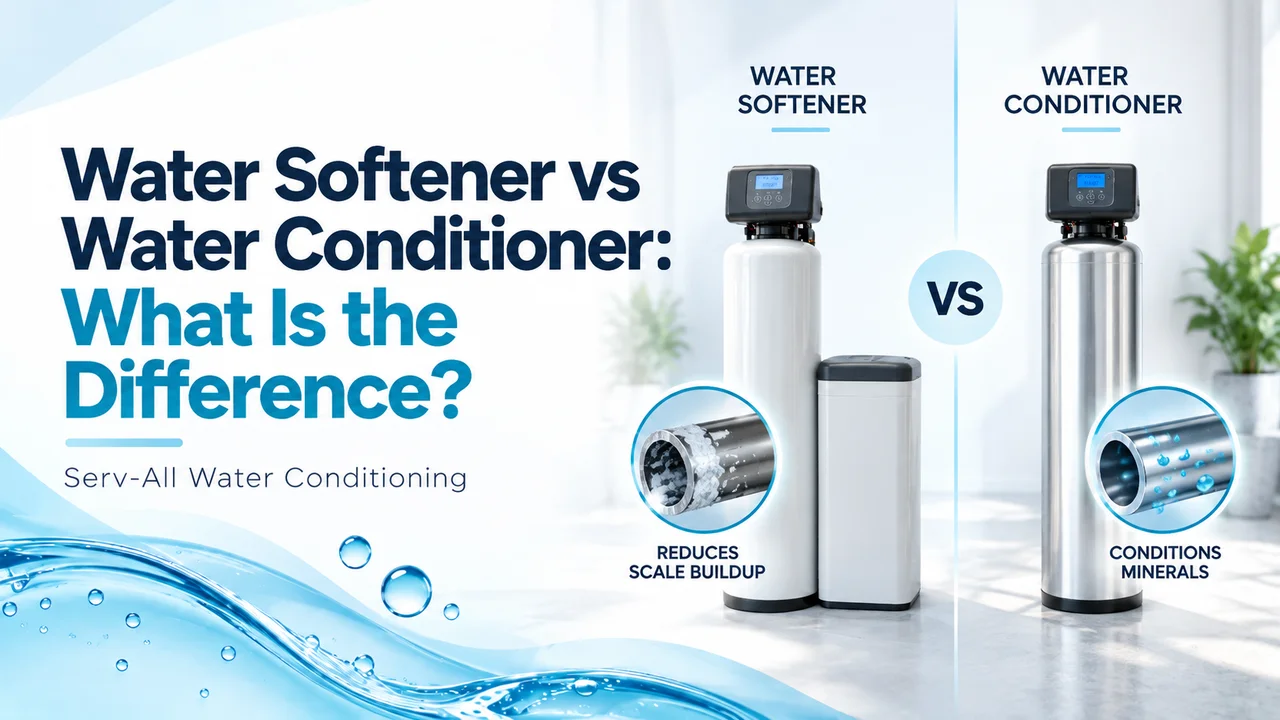
A traditional water softener removes hardness minerals through ion exchange. The term water conditioner is broader and can describe several technologies, including salt-free systems that aim to change how hardness minerals form scale without removing them from the water.
That distinction matters. If you want measurable soft water and maximum reduction of calcium and magnesium, a softener is usually the direct choice. If you want a salt-free approach focused mainly on scale behavior, a conditioner may fit, but its expected results should be explained clearly.
Quick Comparison
A water softener:
- Removes calcium and magnesium through ion exchange
- Uses salt or potassium for regeneration
- Requires a drain and periodic regeneration
- Produces measurable changes in hardness
- Commonly improves soap performance and reduces spotting
A salt-free conditioner:
- Usually leaves hardness minerals in the water
- Does not use conventional brine regeneration
- Is generally intended to reduce scale attachment or change crystal behavior
- May have lower routine maintenance
- Does not create the same soft-water feel or soap response
Because “conditioner” is used for different products, always ask what the proposed technology actually does.
How a Water Softener Works
Inside an ion-exchange softener, resin beads attract calcium and magnesium. The treated water then continues into the home with far less hardness. When the resin reaches capacity, the control valve begins regeneration. Brine passes through the resin, releases the hardness minerals, and sends them to the drain.
This process is well established and can be tested by comparing hardness before and after treatment. Proper sizing depends on incoming hardness, household water use, and required flow rate.
Benefits often include less scale, easier cleaning, improved detergent performance, clearer fixtures, and better protection for water-using appliances. The tradeoffs are salt replenishment, regeneration water, drainage, and periodic service.
How a Water Conditioner Works
A salt-free conditioner may use template-assisted crystallization or another process intended to change the physical behavior of hardness minerals. The minerals remain present, but the treatment may make them less likely to attach as hard scale under suitable conditions.
Because hardness is not removed, a standard hardness test may show a similar reading before and after treatment. Users may still see spots when water evaporates because minerals remain behind. Soap performance may also differ from what people expect from genuinely softened water.
Some products called conditioners use entirely different methods. Review the manufacturer’s mechanism, test data, limitations, flow rating, and certifications. Do not assume all salt-free devices produce equivalent results.
Which System Is Better for Las Vegas Hard Water?
Las Vegas water is commonly described as very hard. A homeowner seeking the strongest reduction in mineral scale will usually find ion-exchange softening more predictable. A household that wants to avoid salt handling or a drain connection may consider a conditioner, provided expectations are realistic.
Serv-All’s water conditioning services can help compare technologies based on measured hardness, plumbing, space, and the specific outcome you want.
Choose a softener when:
- You want calcium and magnesium removed
- Scale is affecting fixtures or appliances
- Better soap and detergent performance is important
- You want an easily measured reduction in hardness
- You can support salt storage, drainage, and maintenance
Consider a conditioner when:
- A salt-free process is a priority
- The goal is scale management rather than mineral removal
- You understand that spotting may continue
- Installation conditions do not suit conventional regeneration
- The chosen technology has appropriate evidence for the application
Maintenance and Operating Differences
A softener needs salt or potassium, periodic resin and brine-tank care, and correct programming. Metered systems regenerate according to water use, which can improve efficiency compared with fixed schedules.
A conditioner may require cartridge, media, or prefilter replacement. “Salt-free” does not mean “maintenance-free.” Media capacity, water chemistry, sediment, and chlorine can influence performance.
For either system, ask for the expected maintenance schedule and annual operating cost in writing.
What About Drinking Water?
Neither term automatically means complete drinking-water filtration. A softener addresses hardness. A conditioner generally addresses scale behavior. Taste, odor, sediment, and specific contaminant concerns require separate evaluation.
Some homes combine whole-home hardness treatment with point-of-use reverse osmosis at the kitchen sink. Others add carbon filtration when chlorine taste or odor is the concern. Each stage should have a defined job.
How to Compare Product Claims
Use a practical checklist:
- Identify the measured hardness.
- Write down the result you want.
- Ask whether minerals are removed or altered.
- Request third-party performance information.
- Check the rated service flow.
- Review pressure-drop data.
- Confirm installation requirements.
- Calculate annual salt, media, and service costs.
- Ask how performance will be verified.
- Review warranty exclusions.
Be cautious when a product promises all the benefits of soft water while stating that hardness minerals remain unchanged. The result may still be useful, but it should be described accurately.
Installation Considerations
A softener generally needs access to the main water line, electricity, a drain, and space for the resin and brine tanks. A bypass valve allows water service during maintenance.
A conditioner may have a smaller footprint and no regeneration drain, depending on the design. It still needs correct orientation, flow capacity, and access for media replacement.
Professional water softener installation helps ensure that capacity, programming, drainage, bypass plumbing, and startup testing match the property.
Frequently Asked Questions
Final Takeaway
Choose a water softener for measurable hardness removal and the familiar benefits of soft water. Consider a conditioner when salt-free scale management is the priority and you accept that minerals remain.
The best system is the one whose mechanism, limits, capacity, and maintenance match your water and expectations.