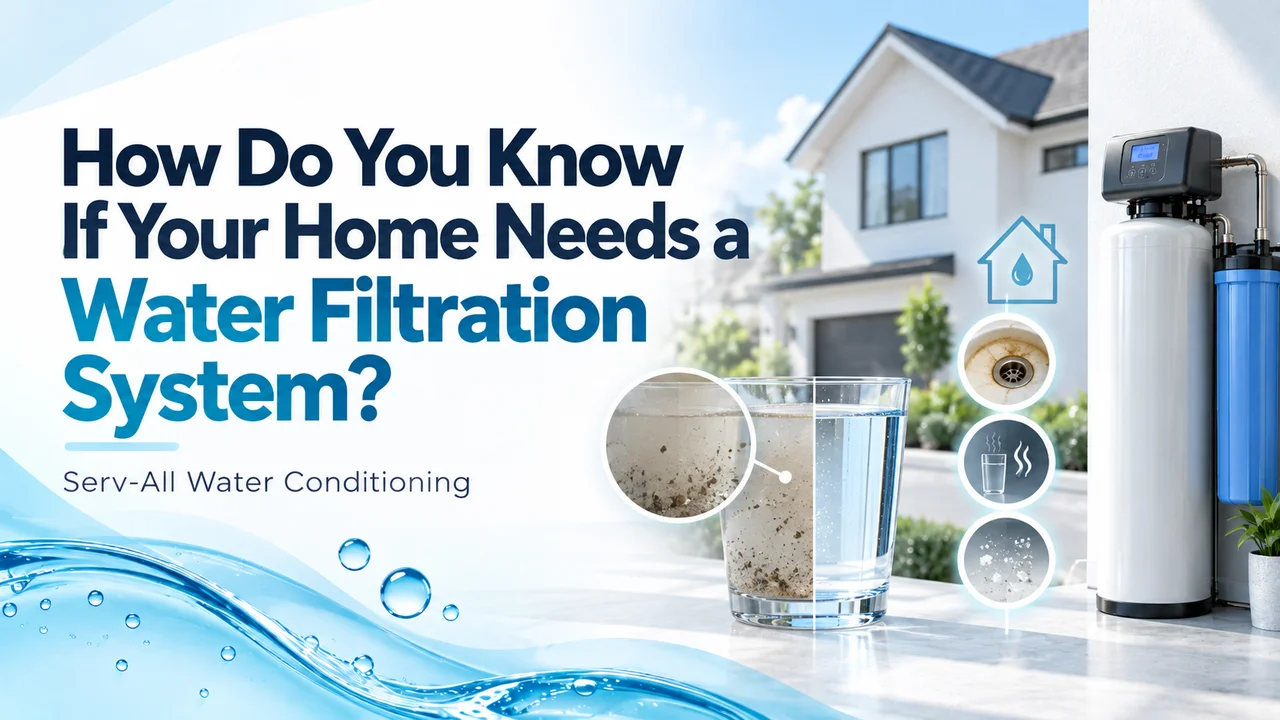
Your home may benefit from a water filtration system when you have a specific, recurring water concern that a properly selected filter can address. Common reasons include unpleasant chlorine taste or odor, visible sediment, discoloration, or a verified contaminant concern. Hard-water scale alone, however, usually points to a softener rather than a standard filter.
The best way to decide is to identify the symptom, investigate its source, test when appropriate, and match the result to a technology with a verified reduction claim.
Quick Answer: What Are the Main Warning Signs?
Consider filtration when water has a persistent objectionable taste or odor, visible particles repeatedly appear, discoloration continues after plumbing issues are ruled out, or a test identifies something you want to reduce. You may also want filtration if you rely heavily on bottled water because tap water is unpleasant.
One isolated event does not always justify a permanent system. Utility work, water-heater conditions, or plumbing repairs can temporarily change appearance or odor. Start by checking whether the concern occurs at one faucet, only with hot water, or throughout the home.
1. Persistent Chlorine Taste or Odor
Municipal disinfectants help protect water as it travels through the distribution system. Some households still dislike the taste or smell. Activated carbon can reduce certain aesthetic chlorine concerns when the filter is designed for that purpose.
If the issue occurs only at one tap, the faucet aerator or local plumbing may be involved. If it occurs throughout the home, a point-of-entry carbon system may be considered. A smaller drinking-water filter may be enough when the concern is limited to cooking and drinking.
2. Visible Sediment or Particles
Sand, rust flakes, silt, or other particles can clog aerators, affect appearance, and shorten the life of downstream equipment. Sediment filtration is selected by particle size and flow requirements.
Do not assume every cloudy glass contains sediment. Tiny air bubbles often make water appear milky and then clear from the bottom upward. Persistent particles that settle are different and deserve inspection.
3. Unusual Color
Yellow, brown, orange, or blue-green water can have different causes. Disturbance in a water main, corrosion, the water heater, or internal plumbing may be responsible. A filter chosen without identifying the source may mask the symptom without correcting the cause.
Check whether discoloration affects hot water, cold water, or both. Contact the water provider when multiple properties are affected. A plumbing inspection may be needed when the issue is limited to the home.
4. Unpleasant Odor
Odors should be diagnosed before treatment. A rotten-egg smell that appears only in hot water can be associated with the water heater. An odor at one drain may come from the drain rather than the water. Earthy or musty odors may have other causes.
Fill a clean glass, move away from the sink, and smell the water again. This simple step can help separate a drain odor from a water odor. Persistent concerns warrant testing or professional evaluation.
5. A Verified Contaminant Concern
Health-related treatment decisions should be based on reliable test results and a filter certified for the specific reduction claim. Different technologies address different substances. NSF/ANSI 42 commonly covers aesthetic effects, while NSF/ANSI 53 covers specified health-effect reduction claims. Reverse osmosis systems may be certified under NSF/ANSI 58.
Private-well owners have different responsibilities from municipal-water customers and should follow local health guidance for testing. No filter should be treated as a substitute for proper well testing.
6. Frequent Bottled-Water Purchases
If your household buys bottled water mainly because tap water tastes unpleasant, a point-of-use system may improve convenience and reduce recurring purchases. The solution does not always need to treat every bathroom, hose bib, or laundry connection.
Compare the annual cost of bottled water with cartridge replacement, maintenance, and installation. Select a system based on the desired result, not on the number of stages advertised.
7. Filters Clogging Too Quickly
Existing cartridges that become dirty or restrictive far sooner than expected may indicate a high particle load, a sizing problem, or a change in incoming water. Installing more filters is not automatically the answer. The source, micron rating, housing size, and flow demand should be reviewed.
Why Water Testing Matters
Visual clues cannot identify many dissolved substances. Professional water testing helps determine whether the concern is hardness, sediment, an aesthetic issue, or something requiring a specific certified treatment claim.
Testing also prevents confusion between filtration and softening. White scale and spots usually come from hardness minerals, which standard carbon or sediment filters do not remove.
Whole House vs Point-of-Use Filtration
A whole house system treats water near the point where it enters the home. It may be appropriate when the problem affects bathing, laundry, fixtures, and multiple taps. Serv-All’s water filtration systems can be configured around the identified concern and the home’s flow requirements.
A point-of-use system treats one location, usually the kitchen sink. It can be the more efficient choice for drinking and cooking water. Reverse osmosis is one example, but it also requires filter and membrane maintenance.
Questions to Ask Before Installation
Ask the provider:
- What test result or symptom supports this recommendation?
- What exactly is the system designed to reduce?
- Is the reduction claim independently certified?
- What flow rate can the system maintain?
- How often will cartridges or media need replacement?
- What will annual maintenance cost?
- Will the system reduce water pressure?
- Is a bypass included for servicing?
- How will performance be verified after installation?
Avoid vague claims such as “removes everything.” Every technology has limits, and every system needs maintenance.
Frequently Asked Questions
Final Takeaway
Your home may need filtration when a persistent, identified concern affects water quality or usability and a specific filter can address it. Start with the simplest accurate solution. Test where necessary, verify certification, size for flow, and understand maintenance before buying.
A problem-first approach produces better results than selecting a generic system based on marketing claims.